
Spiritual Burnout and the Way Back to Rest
You know that feeling. You feel tired—not physically so much, but inside—like your heart doesn’t have the same “pump.” Maybe there’s a deep sadness you’re not sure where it’s coming from, but it’s deep; internal enough for you to hide when you need to, but it comes out in those quiet times… if you even allow for quiet time anymore.
You may assume I’m going to say, “It’s ok. It’s normal to feel like this.” But I’m not. Because it’s not normal.
Normal means this is an acceptable standard. But for me, these feelings aren’t acceptable, and they’re not the standard I’m looking for. I won’t accept this as my norm—but I won’t be harsh with myself over it either.
So what do you do?
Prayer isn’t working, and worship is feeling dry. Reading the Bible is impossible—your mind keeps going to other things to distract you from the restlessness. You want to feel good, but you don’t. You’ve been praying, hoping, and believing, and it hasn’t come. Nothing even feels close to coming.
But it makes no sense. The Bible says faith as small as a mustard seed can move a mountain. So what’s wrong? We can trust God’s promises… can’t we? Those who hope in the Lord… right?
Psalm 77 was the closest I could find to explaining how I was feeling one morning. I’d been believing for something for years—a few somethings, actually—and this desert valley was drier than sandpaper.
And that’s when I realized: my faith was exhausted.
You know that feeling when the only words you can muster to explain what you feel are “I’m tired”? Yeah, that. Because that’s what was really happening. I was tired of having to have faith to believe for what I needed.
But not just tired. Spiritually exhausted. Drained dry. The crying-out-of-nowhere kind of tired—like a child does when he or she needs a nap. That’s spiritual burnout in real life: not quitting God, but feeling like you don’t have anything left in you to keep pushing.
Psalm 77 starts there. The writer—attributed to Asaph (or the Asaph worship tradition)—cries out to God, searches for Him, and still can’t find comfort (Psalm 77:1–2). A worship leader is saying this. A songwriter. Someone whose life is built around putting words to worship and leading others to connect with God.
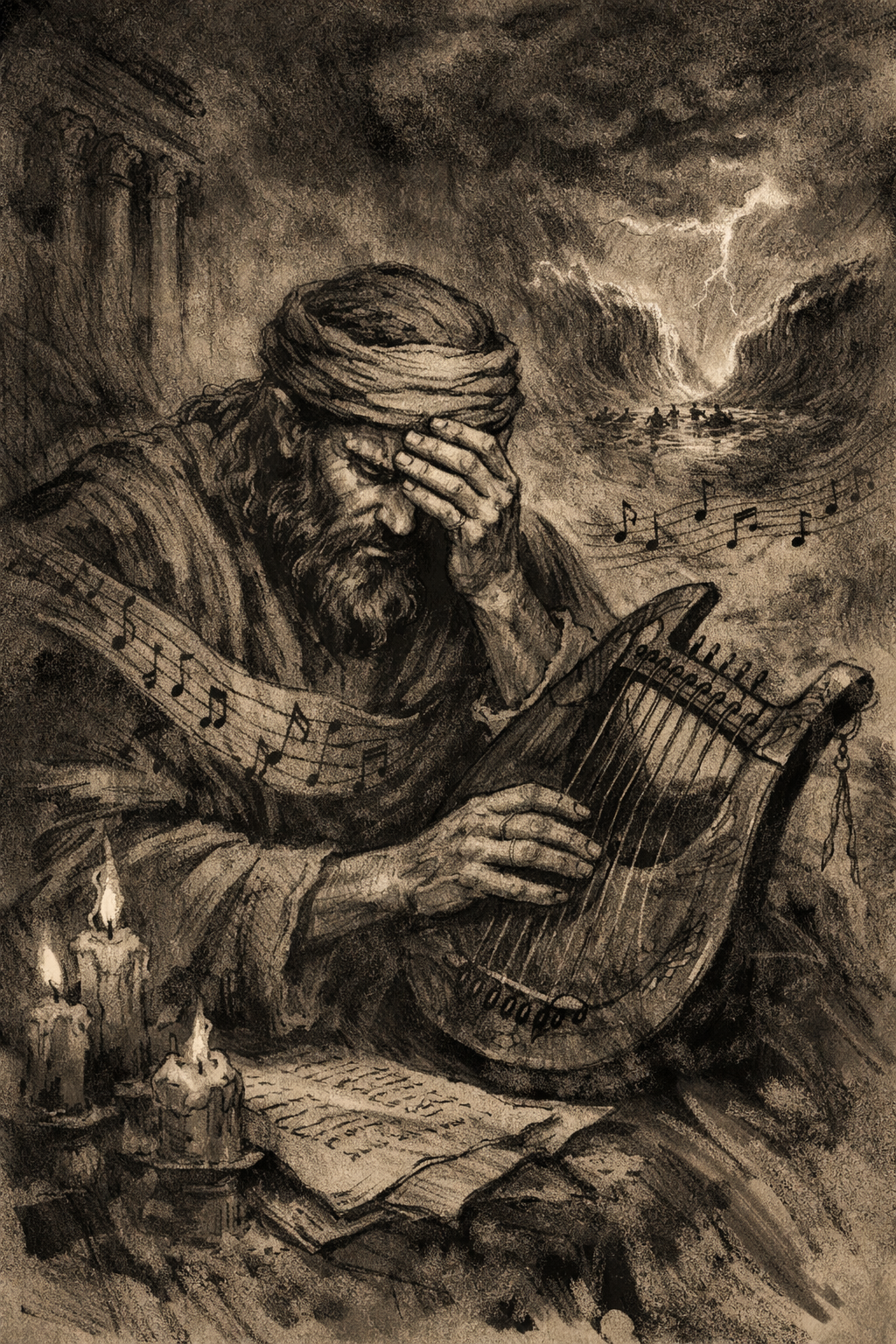
And he’s saying it hasn’t fixed him.
This is a huge problem. Others are counting on him to be “ok,” and he’s not. Far from it.
Verse 3 aligns with what many people feel but won’t say. Essentially: “Even thinking about God right now isn’t soothing me—it’s intensifying my pain.”
Whoa.
I’ve felt this in a valley. Yes, God is good. God is great. He’s God. He’s mighty and awesome… so why am I still here? Where is the awesomeness? Where’s the mighty God who can make the heavens roar with thunder and set the earth in its place and part the Red Sea? Why am I still here in this place? I’m still in the struggle. He can do the impossible… but He hasn’t done it for me.
And that dichotomy is the ache.
That’s why thinking about Him is hard. Worshipping is painful. Reading is distracted and prayer feels frustrating. Because no matter what, there’s silence from the Father, who we hope hears our cry.
But it’s the selah at the end of this verse that shows you how genuine the Bible can be. Selah means to stop. Verse 3 is heavy and real—so don’t brush past it. Sit here and feel it.
We need to process this truth: God hasn’t made it better (yet). God hasn’t answered (yet). And that will happen. There will be long periods of time—days, weeks, months, years—where God doesn’t come through as you hope. This is a truth.
But the psalm doesn’t end here. The story doesn’t end here. No one’s story does.
“You hold my eyelids open” (verse 4) could be insomnia or restless sleep. Or it could be overstimulation—everything is just too much at times. He’s so overwhelmed, he cannot speak. In other words, he’s in shut-down mode.
It’s his job to write and make music, and he cannot do what he’s called to because his soul is overwhelmed with grief. I think we’ve all been there—times we wish were moments, but they last longer than we’re comfortable with. The time stretches so long that the things that brought us meaning don’t feel the same. In a sense, he’s numb.
But then he does something outside of what he’s feeling. He reflects backward to “the days of old” in verse 5. This is the fork in the road.
Verse 6 is healthy psychology in action. The writer speaks—literally with his mouth—which activates and directs his mind toward a specific path to find his “song in the night.” He’s scanning his memory for another dark time when God came through. He’s digging past his feelings to face reality. Not what he should feel. Not what he hopes to feel. What does he feel right now?
When we reach verses 7–9, we see the mechanics of his cries. And they’re not much different than our own. His questions reveal what we all walk through: lack of trust, fear of rejection, fear that God has changed, fear that God is angry, fear that God’s grace has run out.
And then again—another selah. Stop. Hold this burden for a beat. Don’t rush past it. Let it hold a mirror up to your soul and show you where it hurts.
Verse 10 is the hinge. Translations vary, but the meaning lands in the same place: he names the grief—it feels like God’s saving hand isn’t moving the way it used to—and he chooses a response. He will appeal to what he knows of God. This is where worship becomes surrender—not because he feels better, but because God is still God.
This is actual worship. True surrender. Not because I feel it, but because God is God—and I will still honor You.
Once more, he speaks physically: “I will remember the works of the Lord.” Again, training his mind to take the harder path.
Verses 11–20 read like a resume of God’s goodness, faithfulness, authority, and strength. But it’s part b of verse 19 that helped me personally:
“Yet your footprints were unseen.”
If we’re being honest, we don’t actually see God walking with us or moving in our situation in real time. We see it in hindsight. The testimony is after the test.
And this psalmist reminded me: we’re not going to see God move while we wait. We can’t rely on seeing Him move, or it’s not faith.
So what do you do when your faith is exhausted—when you’re in spiritual burnout?
You need to rest.
First, realize we only get tired because we haven’t rested. It doesn’t mean we don’t have faith; it means our capacity is depleted and our bandwidth is low. But what haven’t we rested from? The fears, the doubts, the over-responsibility of trying to control the situation, the pain of potential rejection from God because you’ve been rejected before?
Psalm 77 shows the writer over-processing and over-analyzing, which is always exhausting.
Maybe we’re exhausted because we’ve been so good and did everything “right” and still no answer—like love from God comes from performance. Or maybe we’re using prayer as a lever to control God, rather than a place to lay down burdens.
None of this is uncommon. But it’s in God’s silence that we see what’s inside of ourselves—and what our real relationship with God is.
To feel rested—real rest—we have to release the load once it’s recognized, and find a safe place. This is why the psalmist re-anchored his mind in God’s power and authority and reminded himself that God’s footprints are unseen.
He made his safety in what God had already done, because it was an unchangeable and historical fact.
Re-anchor
To anchor means to go back to God’s truth—what you know about God, not what you feel.
The last time I believed God, He answered by doing ________.
It’s the word of your testimony, Bible testimony, and the testimony of your friends and family who have also walked through a valley.
You also have to re-anchor your commitment to God. And this is the scary part. This is the part where you can decide you’re done. You might decide you’re no longer going to trust God. You might walk away altogether, because that’s exactly the temptation.
But if God doesn’t “do it,” does that make Him not God?
Is He unworthy of praise because what you hope for doesn’t happen?
Be real with your non-negotiable and tell Him. “If X happens, I’m not sure I can follow God anymore.” Sounds dramatic, but people walk away from God daily because of disappointments and unmet expectations.
It helps to be real here—and re-anchor.
Replenish
When Elijah was running from Jezebel, God fed him (1 Kings 19). God also let him sleep and fed him again. Then He encouraged him.
Even God knew Elijah needed to rest and replenish. He was depleted. He was willing to die. He needed food, rest, and encouragement.
We’re no different. Even if our replenishment isn’t physical, we need sleep or peace, we need to refeed our souls, and we need to be encouraged. These are basic principles, but our striving nature makes us vulnerable to weakness.
Constantly putting out—praying, seeking, hoping, pushing faith forward when reality is screaming at its impossibility—depletes us if we’re not refilling on a daily basis through spiritual disciplines.
This is why Jesus would often go off to be alone (Luke 5:16) and pray. That word “pray” also carries the idea of worship—putting God in His rightful place of authority and majesty, so our issue seems small by comparison.
Truthfully, this is easier said than done. You can’t hit pause on your hopes and dreams, or your need for healing, or your need for provision. The valley is still there every morning.
But when you choose the plan God prescribes, the waiting itself produces another healing and draws you closer to Him.
Not only are you still remaining in faith for your miracle, but you’re also being renewed in mind and healed in soul from limiting factors like fear, doubt, and the need for control.
Because suffering produces perseverance; perseverance, character; and character, hope (Romans 5:3–4).
So the next time you feel tired—that inside-the-soul kind of exhaustion—most likely you need to rest, replenish, and anchor yourself in God’s character… until the strength of who He is brings new strength to your soul to rise again.
 Becoming Invincible